
Článek
Real-World Software Development Is Changing—But the Hard Parts Remain Human
Software development is entering a new phase in which writing code is increasingly only one part of the job. Artificial intelligence can generate functions, explain unfamiliar code and help developers troubleshoot problems, but real-world software development still depends on requirements, architecture, testing, security, deployment and the difficult work of maintaining systems after launch.
That distinction is becoming more important as AI coding tools move from experimental utilities into everyday development workflows. Stack Overflow's 2025 Developer Survey found that 84% of respondents were using or planning to use AI tools in development, while 51% of professional developers said they used them daily. Yet the same survey found that more developers distrusted AI output accuracy than trusted it.
The result is a software industry adopting faster development tools without eliminating the engineering discipline required to turn code into dependable products.
What Real-World Software Development Actually Involves
Real-world software development is broader than programming. It covers the complete process of turning a business or user requirement into software that can be deployed, operated, secured and maintained.
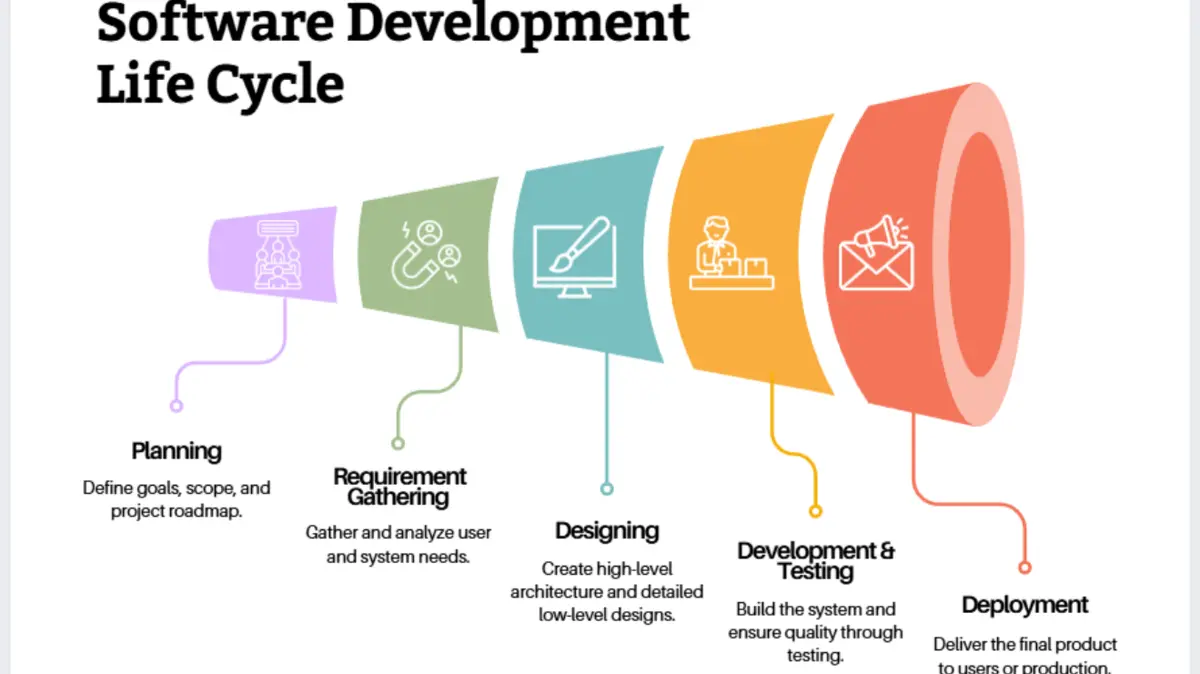
A typical project may involve requirements gathering, system design, database modeling, API development, frontend engineering, testing, deployment and monitoring. Teams also have to manage documentation, version control, code reviews and communication between engineering, product, security and operations groups.
From prototype to production
A developer can now produce a working prototype remarkably quickly with modern frameworks and AI-assisted coding tools. Production software presents a different challenge.
A prototype can ignore unusual inputs, temporary failures and future maintenance. A production system cannot. It must account for authentication, authorization, data integrity, performance, observability, backups, dependency updates and recovery when components fail.
This is why speed of code generation should not be confused with speed of software delivery.
The Modern Development Stack
Today's software teams operate across a large ecosystem of programming languages, frameworks and infrastructure services.
Python has gained particular momentum. Stack Overflow's 2025 survey recorded a seven-percentage-point increase in Python adoption from 2024 to 2025, reflecting its expanding role in artificial intelligence, data science and backend development. Visual Studio and Visual Studio Code also remained among the leading development environments for the fourth consecutive year.
Cloud platforms have further changed how applications are built. Instead of purchasing and managing physical servers, teams can combine managed databases, container platforms, serverless functions, object storage and automated deployment systems.
The advantage is flexibility. The drawback is complexity. A modern application may depend on dozens of external services and open-source packages, creating operational and security responsibilities that did not exist in simpler software stacks.
AI Is Becoming Part of the Workflow
AI-assisted programming is arguably the biggest recent change in software engineering.
Developers increasingly use large language models to generate boilerplate, explain documentation, write tests, refactor code and investigate errors. Some tools can work across multiple files or perform longer sequences of development tasks with limited supervision.
The adoption numbers show that this is no longer a niche experiment. But the same research reveals substantial reservations. In Stack Overflow's 2025 survey, 46% of developers said they distrusted the accuracy of AI tools, compared with 33% who trusted them. The largest reported frustration was receiving solutions that were almost correct but not quite, cited by 66% of developers.
That gap between apparent productivity and verified correctness is central to real-world software development.
Why human review still matters
Generated code can compile and still be wrong.
It may misunderstand a requirement, introduce a security vulnerability, use an inefficient database query or fail under conditions absent from the developer's prompt. Developers therefore increasingly need to evaluate AI output rather than simply accept it.
Testing becomes especially important. Unit tests can check individual components, integration tests can examine interactions between systems, and end-to-end testing can validate user workflows. None eliminates the need for engineering judgment, but together they provide defenses against subtle errors.
Where Real-World Software Development Matters Most
Software now underpins industries ranging from banking and healthcare to manufacturing, logistics, education and retail.
In financial services, development teams must consider transaction accuracy, fraud prevention and regulatory requirements. Healthcare software introduces concerns around reliability, privacy and interoperability. Manufacturing increasingly depends on software connected to machines and operational systems.
Consumer applications have different pressures. They may need to support millions of users, respond quickly to changing customer expectations and release features continuously.
Across all these sectors, the same principle applies: software has to work in the environment where people actually depend on it.
The Advantages—and Limits—of Modern Development
Modern development practices offer substantial benefits.
Cloud infrastructure can shorten deployment cycles. Automated testing can catch regressions before release. Version-control systems allow distributed teams to collaborate on large codebases. Continuous integration and continuous delivery can automate portions of the path from code change to production.
AI tools add another layer of potential efficiency. The 2025 Stack Overflow survey found that 52% of developers agreed AI tools or agents had positively affected their productivity. Among developers using AI agents, 69% said agents had increased productivity, although collaboration improvements were reported far less often.
But automation has limits.
Software projects can become harder to understand as dependencies multiply. Technical debt accumulates when teams prioritize short-term delivery over maintainability. Security vulnerabilities can enter through application code or third-party components. And organizations can spend heavily on infrastructure without solving the underlying product problem.
AI can accelerate an inefficient process just as easily as an effective one.
The Industry Is Moving Toward Agent-Assisted Development
AI agents represent the next significant development frontier, but adoption remains uneven.
That suggests the industry is still determining where autonomous development provides genuine value.
The strongest near-term applications are likely to remain tasks that can be clearly specified and independently verified, such as test generation, documentation, code search and routine maintenance. More consequential decisions—architecture, security policy, product requirements and production changes—require stronger oversight because mistakes can have broader consequences.
What Comes Next for Software Engineering
The future of real-world software development is unlikely to be defined simply by whether AI replaces programmers. A more immediate change is that the composition of engineering work is shifting.
Developers may spend less time writing repetitive code and more time defining requirements, reviewing generated changes, designing systems, evaluating trade-offs and ensuring software behaves correctly.
That could make engineering more productive, but it may also raise the value of fundamentals. Understanding databases, networking, operating systems, security, algorithms and system architecture becomes more—not less—important when developers are responsible for evaluating code produced by machines.
The central challenge remains unchanged: software must solve a real problem reliably.
AI can accelerate parts of that process. Cloud platforms can simplify deployment. Automation can reduce repetitive work. But successful software still requires clear requirements, thoughtful architecture, rigorous testing and teams willing to take responsibility for what reaches users.
For real-world software development, the defining skill of the next era may therefore not be writing code faster. It may be knowing what code should exist, how to verify it and when not to deploy it.
Resourse Download:
https://drive.google.com/drive/folders/1lfu2SSi7P7bKUd3I5VGlP8zU61V_PIcp