Článek
1. Kissinger’s Shadow and 400 AD: The End of European Universalitas
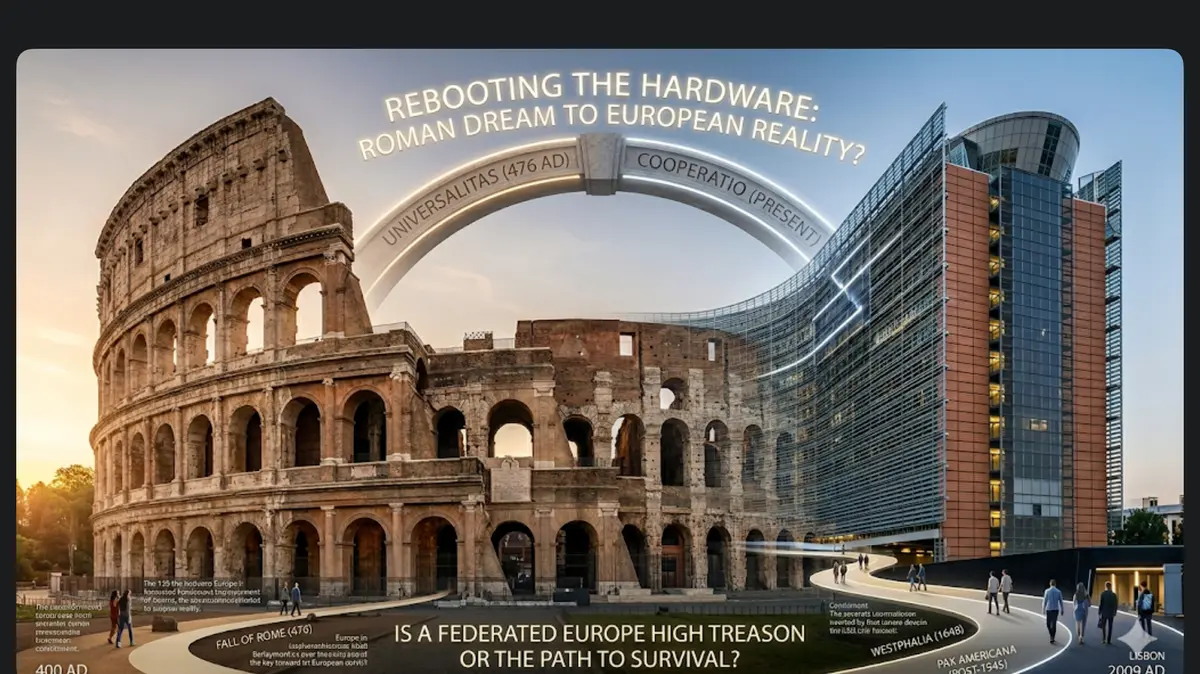
In 476 AD, the traditional date of the fall of the Western Roman Empire, something occurred in Europe that is unparalleled in the history of other civilizations. While China managed to „reunify“ (at least seen from the outside) under a new dynasty after every collapse, the European „Roman hardware“ was irrevocably shattered. With the deposition of Romulus Augustus, the central power that unified law, currency, and security from Britain to the Danube vanished. The concept of Universalitas was dead.
From the 5th to the 17th century, Europe became a laboratory of chaos and fragmentation. As Henry Kissinger argues in Diplomacy (1994), the absence of central authority created a system of thousands of local sovereignties. Any attempt at reunification was perceived as a threat to emerging national identities. This millennium-long resistance to unity culminated in the carnage of the Thirty Years' War (1618–1648). It was the very first „world war“ of a large scale on European soil, proving that religious universalism as a continental glue had failed. This slaughter buried the claim to any universal European government but, paradoxically, prepared the ground for the modern era.
2. Westphalia 1648: Codifying the Divorce of united Europe : the Era of modern statehood and „Balance of Power“
The Peace of Westphalia in 1648 was not just the end of a war; it was the birth of a new World Order. For the first time, it was legally established that the sovereign state is the supreme and inviolable entity. Neither the Pope nor the Emperor remained superior judges. The nation-state was born, and from this perspective, federalization is indeed „high treason“ against the principles upon which modern Europe has stood for nearly 400 years.
To survive, this system had to establish the Balance of Power mechanism. This dynamics, detailed in Paul Kennedy’s The Rise and Fall of the Great Powers (1987), functioned until the catastrophes of the World Wars of the 20th century, when it became clear that internal European balance was no longer sufficient to maintain global peace. After 1945, an anomaly occurred. The traditional role of „balancer“ was assumed by the USA. Europe, exhausted by its own wars, began its „free-rider“ era. Under Uncle Sam’s nuclear umbrella, we outsourced our security. This ride at someone else's expense is now coming to an end.
3. 2008 and Lisbon: Europe in Limbo and the Blow of Brexit
When the 2008 global financial crisis struck, the European project hit its limits. The Lisbon Treaty, signed in 2007 and entering into force in late 2009, was meant to be the answer to an enlarged Union's dysfunction, but the result was a hybrid. Europe found itself in "limbo"—a space where states are no longer fully sovereign, but the Union as a whole is not strong enough to act as a superpower.
This state of paralyzing indecision culminated in Brexit. As Ivan Krastev notes in After Europe (2017), Brexit shattered the illusion of the irreversibility of integration. Europe remains stuck: too integrated to fall apart without total collapse, but too fragmented to defend itself against external pressure.
4. From Eurasia to Asia: The Global Paradigm Shift
The world's gravity has shifted. The „Pivot to Asia“ did not start with Donald Trump; it began under the Obama administration, as documented by Kurt M. Campbell in The Pivot (2016). Washington realized its primary challenger was not in Moscow, but in Beijing. Europe was quietly sidelined as a „solved problem.“
Donald 2.0 has merely stripped the mask off American pragmatism. His „pay up and take care of yourselves“ is the logical conclusion of the fact that the USA no longer wishes to subsidize European social peace through its defense budget. China and India do not see a partner in a fragmented Europe; they see a fragmented market to be manipulated through „divide and rule.“ Without a single voice, European states are becoming mere pawns on someone else's chessboard.
5. Diagnosis: Survival or Irrelevance
Is federalization treason?
If we measure sovereignty through the lens of 1648, then yes—it is, indeed, a betrayal of the Westphalian legacy. But if sovereignty is defined as the real capacity to determine one's own destiny, then clinging to fragmentation is the ultimate treason against future generations. In a system dominated by continental powers (USA, China), a ten-million-Central European States have too little chance of true independence.
Federalization is not a romantic dream. It is a cold, pragmatic necessity, especially for small nations. Either Europe recreates the „Roman hardware“ of the 21st century—common defense, energy, and strategic science—or it will gradually dissolve into geopolitical irrelevance. Treason is not integration. Treason is inaction while the architecture of the world changes around us.
Epilogue: The Cry of the Arena
In the movie Gladiator, Maximus Decimus Meridius famously said:
„If we stay together, we win.“
But today, the Gladiator of Europe speaks a different truth to the arena:
„If we further unite together, we survive!“
We are no longer fighting for the glory of an Empire. We are fighting to ensure that we don't become just another nameless relic in the sands of a new Asian century.
Sources and Recommended Reading:
• Kissinger, Henry. Diplomacy. New York: Simon & Schuster, 1994.
• Kissinger, Henry. World Order. New York: Penguin Press, 2014.
• Kennedy, Paul. The Rise and Fall of the Great Powers. New York: Random House, 1987.
• Krastev, Ivan. After Europe. University of Pennsylvania Press, 2017.
• Campbell, Kurt M. The Pivot: The Future of American Statecraft in Asia. Twelve, 2016.
• Friedman, George. The Next 100 Years. Doubleday, 2009.